Matcha Prices Remain Near Record Highs — and the Structural Squeeze Has Not Yet Eased
SightSpinner Team ·
Matcha Prices Remain Near Record Highs — and the Structural Squeeze Has Not Yet Eased
This series explores to what extent a mostly autonomous system can handle end-to-end economic and financial analysis. Given a topic, data sources, and brief guidance, the system runs on its own. After some light human QA, it generates a full article complete with visualizations of the data.
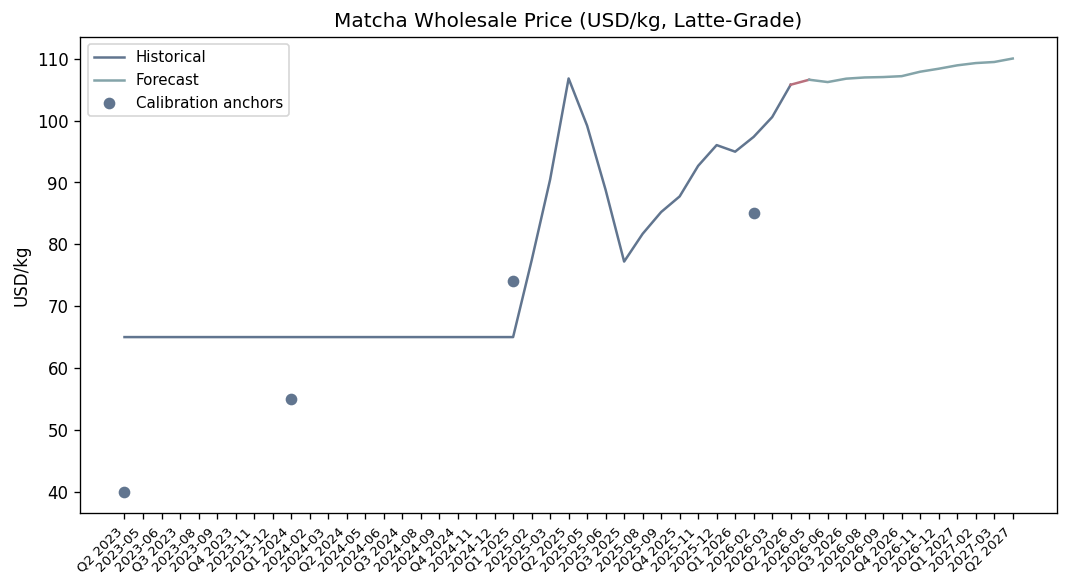
Global matcha wholesale prices have more than doubled from their 2023 baseline and are forecast to stay elevated through April 2027, driven by an acute structural supply shortage at Japan's tencha auction that no amount of Chinese substitution has fully offset. The model projects a latte-grade benchmark of approximately $110/kg by April 2027, more than 2.7× the ~$40/kg level seen three years ago.
What the Data Shows
The headline price series tells the sharpest story. Latte-grade matcha wholesale (USD/kg) stood at a modeled $65/kg through most of 2023–early 2025 — a period when the model was anchored to the First Agri B2B pricing floor — then broke sharply higher: $77/kg in January 2025, $90/kg by March, and $107/kg in April 2025 as the 2025 first-flush auction shock registered in full. The model holds prices in the $105–$110/kg range through April 2027, consistent with the most recent calibration anchors (Q1 2026: ~$85/kg actual; model ~$100–$106/kg by year-end 2025 reflecting hype-inflated demand catching up with constrained supply).
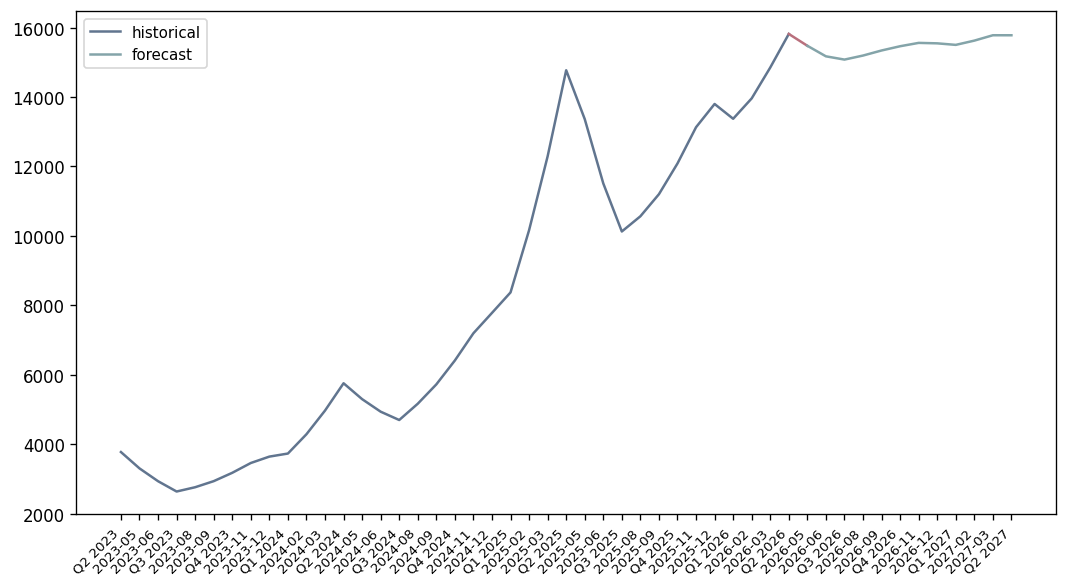
The underlying driver is Japan's tencha auction. The TenchaAuctionPrice_JPY node tracks JA Kyoto first-flush prices from a base of ~¥3,776/kg in April 2023, rising through the 2024 first-flush shock (~¥5,757/kg in April 2024), then exploding to ¥14,772/kg in April 2025 — a level confirmed by Japan Tea Central Association and Ooika July 2025 reporting. The forecast holds auction prices near ¥15,500–15,800/kg through April 2027, as the structural bottleneck in tencha factory capacity and stone-grinding mill output persists.
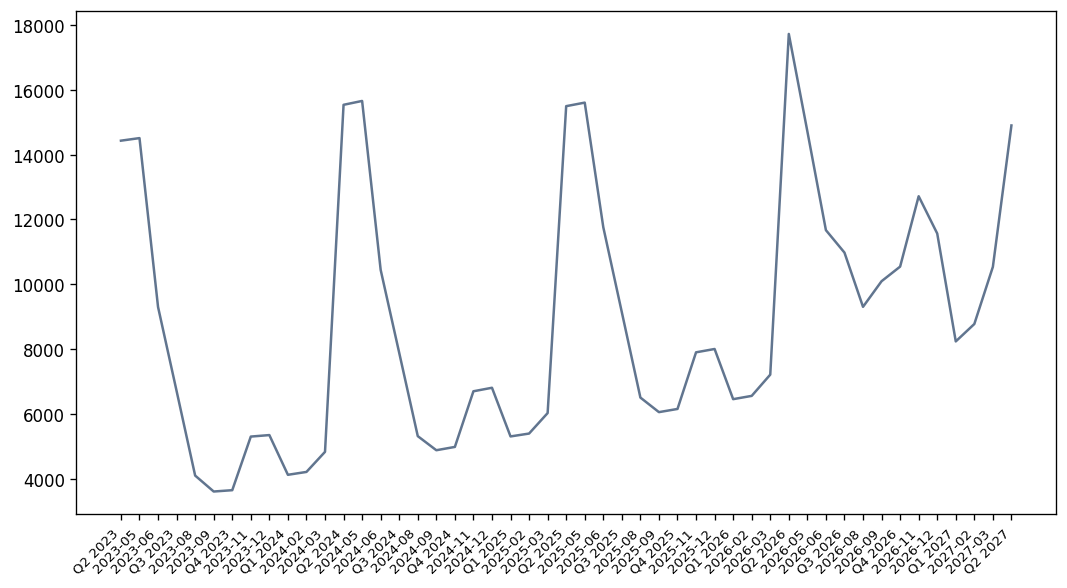
On the supply side, TotalEffectiveSupply — the sum of Japanese tencha output converted to matcha-equivalent plus Chinese matcha treated as a substitute — starts at approximately 14,429 MT/month-equivalent in April 2023 and grows only modestly to 14,898 MT by April 2027. This near-stagnation reflects three compounding bottlenecks: tea plants planted today require 3–5 years to reach harvestable yield; new tencha factories carry a ~24-month construction lead time; and stone-grinding mills face 6–12 month order backlogs from specialist stonecutters. The 2025 first-flush came in roughly 11–13% below the prior year in Kyoto, and reserve stocks exhausted by late 2024 eliminated the buffer that had softened earlier price swings. Japanese supply (JapaneseSupply) stands at ~13,114 MT-equivalent in April 2023 and grows marginally to ~13,164 MT by April 2026 — a near-flat trajectory that confirms how little new capacity has come online. Chinese matcha (ChineseMatchaSupply) grows from ~5,574 MT in April 2025 to ~5,543 MT in April 2026, providing partial but not sufficient relief, and arrives at a 40–60% price discount that erodes profitability and raises quality-consistency concerns for buyers.
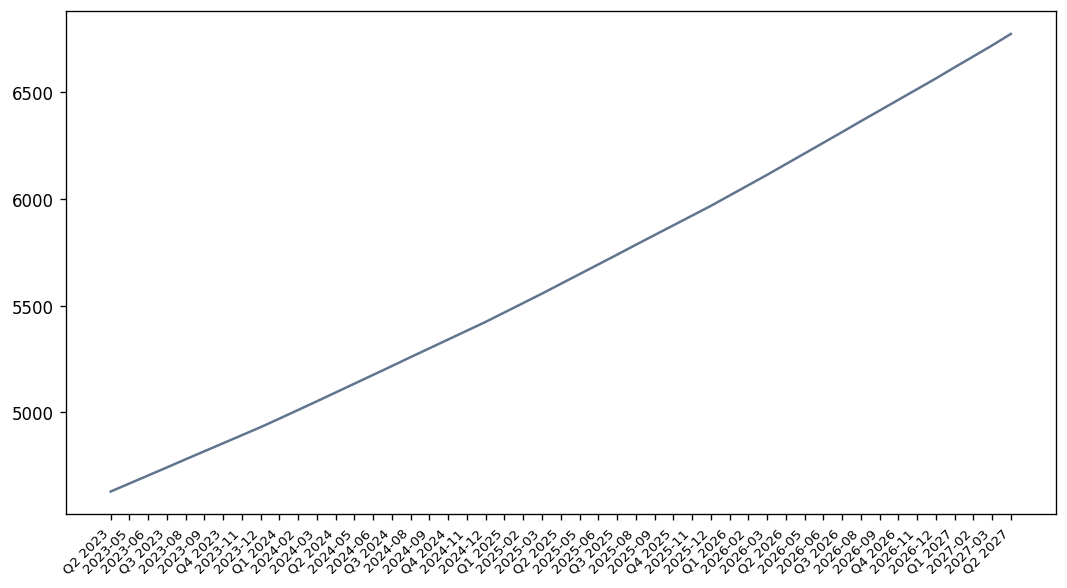
On the demand side, BaselineDemand compounds at 10% annual CAGR — sourced from FMI and SkyQuestT global market size data — and is amplified by a social-media hype multiplier that peaked near 1.6× in late 2024/early 2025. TotalDemand rises from ~4,629 MT/month-equivalent in April 2023 to 6,772 MT by April 2027, a 46% increase over the period. The demand acceleration is corroborated by NIQ retail data (US matcha retail sales +86% over three years, per AP September 2025) and by the observable strain on global wholesale channels.
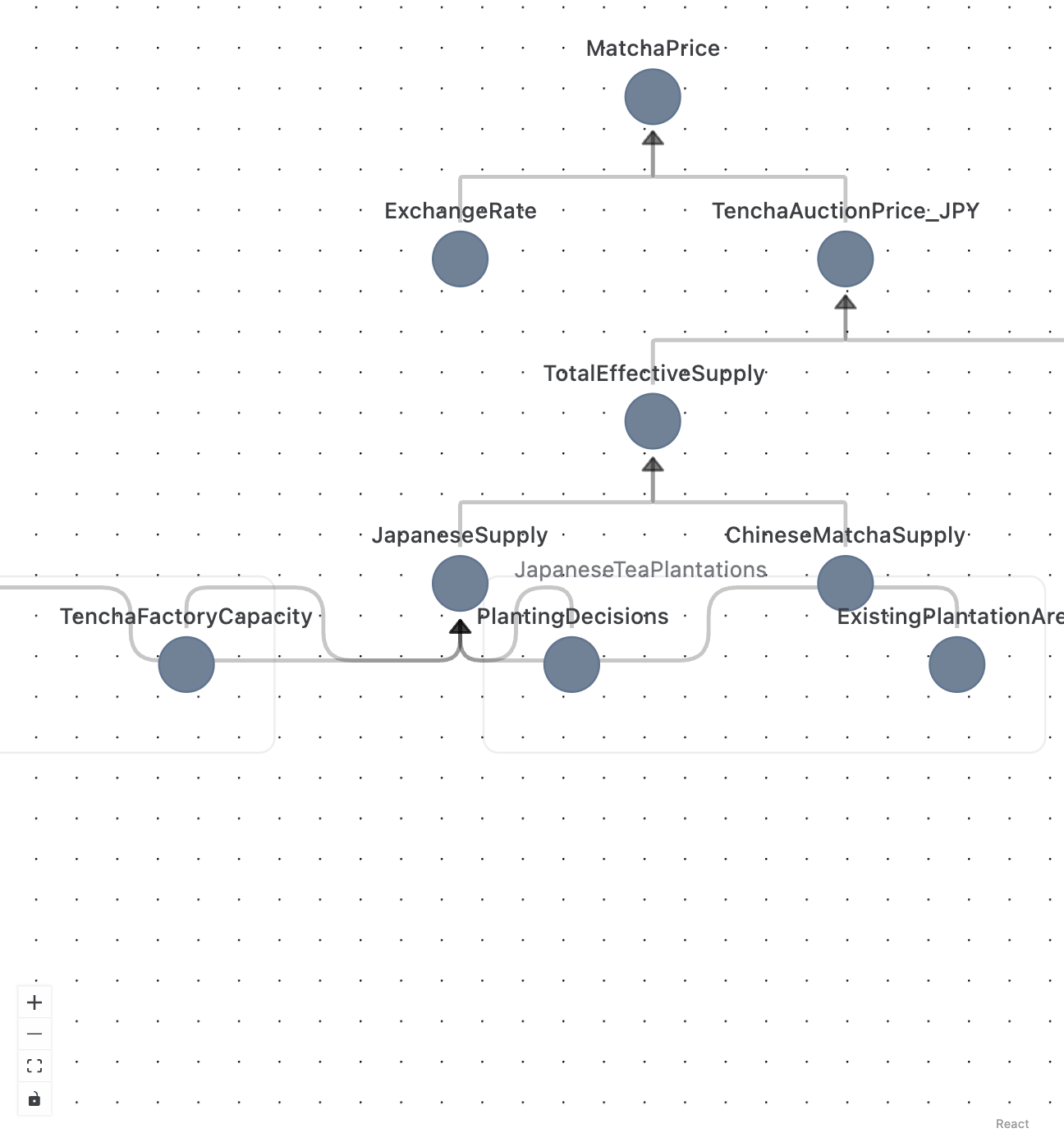
The exchange rate component (ExchangeRate, sourced from FRED series DEXJPUS via live API pull) translates JPY auction prices into USD wholesale. The yen's sustained weakness during 2023–2025 has meaningfully amplified the USD-denominated shock: buyers outside Japan effectively pay a double premium — the underlying auction price inflation plus an unfavorable exchange rate.
Context
This model covers the global matcha wholesale market from April 2023 through a forecast horizon of April 2027 (49 monthly partitions). It targets a single benchmark: latte-grade matcha at the wholesale/B2B level, which is the primary input for cafés, foodservice, and packaged-goods manufacturers globally.
The structural mechanics begin at the farm level in Japan. Tencha — the shade-grown, steamed, and dried leaf that is stone-ground into matcha — is produced almost exclusively in Uji (Kyoto), Nishio (Aichi), and a handful of other regions. Japan Tea Central Association data show 2024 was a record tencha production year at 5,336 MT. Yet the 2025 first-flush fell approximately 11% below prior-year levels, and Ooika's July 2025 matcha industry report confirmed the auction price spike. The PlantingDecisions node models growers' incentive response with explicit multi-year lags: investment decisions made at 2024–2025 prices will not yield harvestable leaf until 2027–2029 at the earliest.
What is real data vs. calibrated assumption: The JPY/USD exchange rate is drawn live from FRED (DEXJPUS). Tencha auction price anchors — ¥3,186/kg average 2023, ~¥5,500/kg 2024 first-flush, ~¥14,333/kg 2025 first-flush — are from JA Kyoto auction records via ITC July 2025 and Ooika reporting. USD/kg wholesale price anchors (Apr 2023 ~$40; Jan 2024 ~$55; Jan 2025 ~$74; Q1 2026 ~$85) are from First Agri B2B Matcha Wholesale Pricing 2026. The demand CAGR (10%), hype multiplier profile, Chinese supply volume estimates, and supply-chain lead times are calibrated assumptions based on FMI/SkyQuestT market research, Tridge analysis, and industry reports (Tezumi "Matcha Shortage Part 2" 2026, Tea Nursery "The Unfolding Matcha Situation" 2026). Buyers should treat the forecast-period values as scenario outputs, not point predictions.
By the Numbers
| Metric | Value |
|---|---|
| Matcha wholesale price — Apr 2023 (historical anchor) | ~$40/kg (calibration) |
| Matcha wholesale price — Apr 2025 (model) | ~$107/kg |
| Matcha wholesale price — Apr 2026 (model) | ~$106/kg |
| Matcha wholesale price — Apr 2027 (forecast) | ~$110/kg |
| Tencha auction price — Apr 2023 | ¥3,776/kg |
| Tencha auction price — Apr 2025 (2025 first-flush spike) | ¥14,772/kg |
| Tencha auction price — Apr 2026 (model) | ¥15,818/kg |
| Tencha auction price — Apr 2027 (forecast) | ¥15,780/kg |
| TotalEffectiveSupply — Apr 2023 | ~14,429 MT-eq. |
| TotalEffectiveSupply — Apr 2027 | ~14,898 MT-eq. (+3.2%) |
| TotalDemand — Apr 2023 | ~4,629 MT-eq. |
| TotalDemand — Apr 2027 | ~6,772 MT-eq. (+46%) |
| Japanese supply (Apr 2023) | ~13,114 MT-eq. |
| Japanese supply (Apr 2026) | ~13,164 MT-eq. (near-flat) |
Forecast Outlook and Key Uncertainties
The model's central scenario sees prices plateauing in the $105–$110/kg range rather than retreating materially. The key reason: even as the social-media hype multiplier fades from its ~1.6× peak toward ~1.3× by April 2027, structural demand growth absorbs the slack, and supply remains physically constrained by multi-year agricultural and manufacturing lead times.
Upside price risks: A second consecutive poor first-flush in Kyoto (weather, disease), further yen depreciation, or a surge in Western quick-service restaurant adoption could push prices above $120/kg.
Downside price risks: Faster-than-expected Chinese supply scaling (Chinese output is modeled at ~5,000–5,574 MT/year and growing), significant consumer trading-down to lower-quality blends, or a sharp yen rebound could ease the USD benchmark. A 2026–2027 bumper harvest in Japan, triggered by 2024–2025 planting incentives, could begin arriving as early as late 2027 — outside this model's horizon but the most plausible medium-term relief valve.
For procurement teams: the model supports a strategy of locking in multi-year supplier contracts at current levels rather than betting on near-term relief. The supply-chain bottlenecks — three to five years for new plantation area, two years for factory construction, six to twelve months for mill capacity — mean any recovery in supply will be gradual and back-end loaded. The window for opportunistic spot buying at pre-2025 prices has closed.
Data sources: FRED DEXJPUS (USD/JPY monthly); Japan Tea Central Association production data; JA Kyoto tencha auction records via ITC July 2025 report and Ooika July 2025 Matcha Industry Report; FMI and SkyQuestT global market size; NIQ retail sales data (AP, Sept 2025); First Agri B2B Matcha Wholesale Pricing 2026 (first-agri.jp/matcha/columns/041); Tridge Chinese matcha analysis; Ooika "Japanese and Chinese Matcha" Mar 2026; Tezumi "Matcha Shortage Part 2" 2026; Tea Nursery "The Unfolding Matcha Situation" 2026.